ALTER EGO
- 4.8
- Rating
- 1.00M
- Installs
- Free
- Price

 Analysis by App-foxy
ALTER EGO is an adventure game that immediately asks me to slow down and pay attention. Rather than pushing me toward constant action, it builds its experience around interpretation, mood, and the meaning I attach to what I encounter. Its central idea is simple but effective: the way I read a situation influences the story I experience. That makes it feel closer to a reflective interactive tale than to a conventional action adventure.
After spending time with it, I understand why the game has attracted such a large audience. It holds an average rating of 4.8 from around 138 thousand ratings, and its audience has passed one million installs. Those figures are useful context, but they are not the main reason I would recommend it. The stronger reason is that the game knows exactly what kind of experience it wants to provide. It is quiet, strange, personal, and sometimes deliberately uncomfortable.
Caramel Column Inc. released the game on December 27, 2018, and the current version is 3.10.4. It is free to start, with optional in-app purchases ranging from $1.99 to $9.99 per item. The Teen content rating is worth taking seriously because the themes are more thoughtful and psychologically charged than the soft visual presentation might first suggest. It runs on Android 7.0 or later, so many older devices can still access it.
You May Also Like

 Blood Strike: 2.5 Anniversary
Blood Strike’s Loadouts Turn Every Drop Into a Tactical Gamble
A close look at Blood Strike’s custom loadouts: how fast access to signature weapons reshapes its battle royale rhythm, rewards preparation, and narrows the gap between fights.

 Pandora - Music & Podcasts
Pandora’s Music Is Easy to Start, but Harder to Recover
Pandora’s strength is its low-effort path from a seed to a station. Its weak spot is how much confidence it asks you to place in connection, setup, and quiet recovery.

 8 Ball Pool
 Is Built on Rivalries, Rematches, and Routine
A close look at the rivalries, rematches, shared routines, and unanswered safety questions that turn a quick pool match into a persistent mobile community.

 Samsung Music
’s Quiet Strength Is Playing What You Already Own
Its reach comes less from spectacle than from dependable access to a personal library. That simplicity is both the app’s strongest retention engine and its ceiling.

 AccuWeather: Weather Radar
AccuWeather Review: A Quick, Clear Forecast for Everyday Decisions
For everyday plans, the best forecast is the one you can understand quickly. AccuWeather makes rain timing, radar, and local conditions easy to act on, with a few trade-offs.

 Hill Climb Racing
Why Hill Climb Racing Still Turns Crashes Into One More Run
A tiny car, a bumpy hill and one more upgrade: Hill Climb Racing keeps resurfacing because its simple chaos makes every near-miss feel personal.
More From Our News Desk



A reflective adventure built around interpretation
I like how ALTER EGO makes attention part of the adventure: its quiet presentation leaves room for me to notice what I bring to each scene, rather than simply chasing the next action beat. In the sections that follow, I’ll look at how that approach shapes the game’s atmosphere and storytelling, and where its deliberate pace may ask more patience than some players want to give.
The opening impression is quiet rather than spectacular
My first reaction was that ALTER EGO does not try to win me over with a noisy tutorial or a flood of visual effects. It establishes its identity through restraint. The presentation gives the game room to feel mysterious, and that mystery becomes part of the reason to continue. I was not simply waiting for the next reward; I wanted to understand what the game was trying to say and how my choices were shaping that meaning.
This approach will not suit everyone. Players who expect immediate combat, large maps, or a long list of equipment may find the beginning unusually sparse. The appeal is not in collecting a powerful build or mastering fast reflexes. It is in noticing patterns, considering responses, and seeing how a particular interpretation changes the tone of the journey.
That makes the game especially suitable for short, focused sessions. I can play it when I have a quiet break, then put it down without feeling that I have abandoned a complicated action sequence. At the same time, the reflective structure gives me a reason to return. A brief session can leave a question in my mind, and that question often becomes the motivation for the next one.
A realistic use case is an evening commute or a few minutes before bed, provided the player is comfortable with the game’s darker emotional atmosphere. It works better when I am willing to read and think than when I am distracted by messages or looking for something to fill empty time. The game rewards attention, not background play.
The visual language keeps the focus on the inner journey
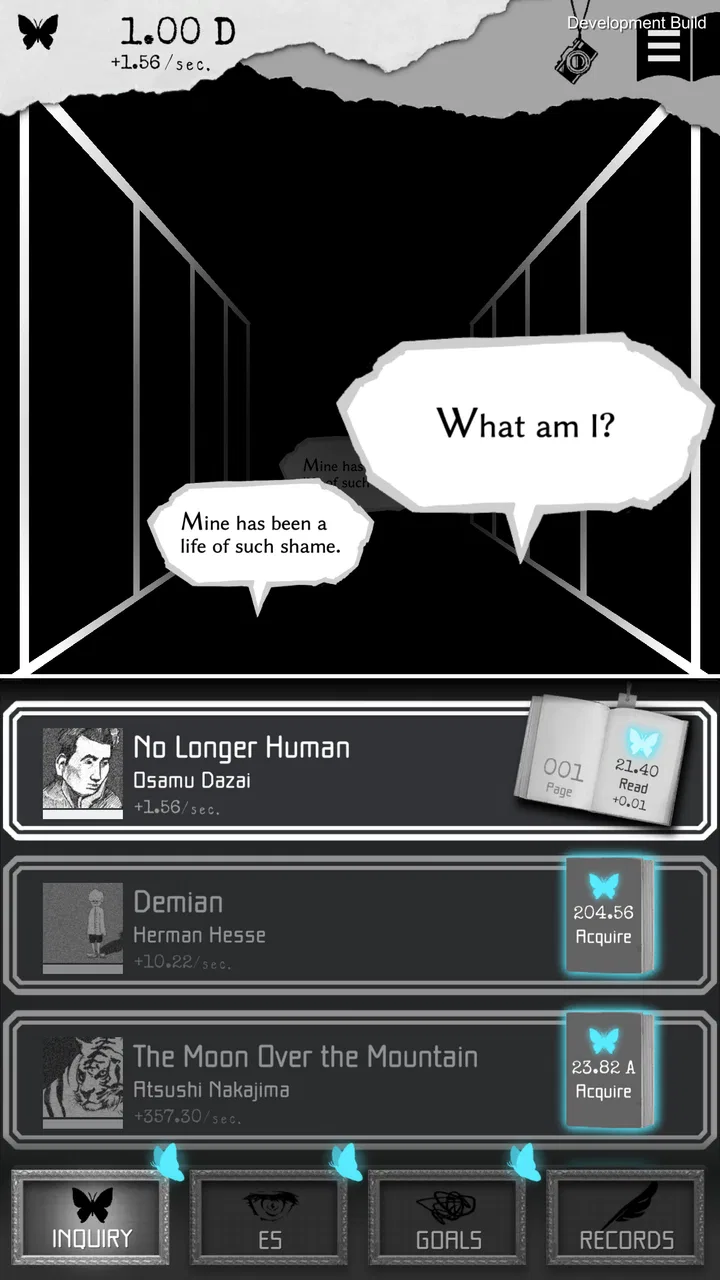
The art direction is one of the clearest ways the game separates itself from ordinary mobile adventure releases. Instead of treating visuals as decoration around a conventional progression system, it uses the presentation to support the feeling of uncertainty. The imagery has a composed, almost literary quality, and that gives even simple moments more weight.
I found that the limited visual approach made me pay closer attention to small changes. When a game is not constantly throwing new effects at me, shifts in expression, framing, color, or placement can carry more meaning. The result is an atmosphere that feels intentional rather than merely minimal. It is not trying to imitate a large console production on a phone; it is building a smaller world with its own visual rules.
The setting also benefits from this discipline. ALTER EGO does not feel like a generic fantasy landscape with interchangeable locations. Its spaces seem designed to reflect the game’s concerns, so the environment contributes to the questions being asked. I often felt that the surroundings were part of the conversation, even when they were not delivering information directly.
One useful way to play is to resist rushing through familiar-looking screens. The game’s mood depends on gradual recognition. If I treat every scene as a prompt to tap through as quickly as possible, I lose some of the connection between the setting and the story. Taking a moment to consider why a scene looks the way it does makes the experience more coherent.
How the story turns interpretation into participation
The store summary describes a principle in which interpretation creates a personal story, and that idea is more important than any single plot detail. I am not just following a fixed sequence while waiting for the next dramatic reveal. My reading of events becomes part of the experience. Two players may notice different implications or respond to the same material with different expectations.
This does not mean every moment behaves like a completely open role-playing game. The structure remains authored, and the game still guides me toward particular themes. Its strength comes from the tension between a designed path and personal interpretation. I am given enough direction to stay oriented, but enough ambiguity to feel involved.
That balance is also why the game can be more rewarding on a second look. Once I understand the broad shape of an encounter, I can pay attention to details that were easy to miss the first time. I may also reconsider an earlier response because I now understand its emotional context differently. The replay value is therefore less about finding a stronger weapon and more about examining the consequences of my own reading.
Players who want a clearly explained plot with every question answered immediately should know what they are choosing. This is not the best fit for someone who dislikes symbolism, indirect storytelling, or unresolved tension. I personally enjoy those qualities, but I also recognize that they can feel vague when I am looking for a straightforward adventure.
Sound gives the quiet scenes their emotional weight
The audio direction works with the art instead of competing with it. The soundscape helps preserve the game’s subdued personality, and that matters because the experience depends heavily on tone. A louder, more aggressive presentation would make the same scenes feel ordinary or melodramatic. Here, restraint helps the setting remain intimate.
I noticed that the pauses are as important as the audible moments. Silence gives a line or transition time to settle, and it prevents the game from feeling like a sequence of prompts that must be consumed instantly. This supports the reflective rhythm: observe, interpret, respond, and then sit with the result.
For that reason, I get more from the game with headphones or in a quiet room. It is still possible to play casually, but background noise can flatten the distinction between a meaningful pause and a simple lack of activity. The audio is not merely there to make the game feel complete; it helps control how quickly I process each scene.
The pacing can be an advantage when I want a calmer experience, but it can also become a limitation. There are stretches where the game asks for patience without offering the kind of immediate interaction found in more conventional adventure titles. If I am tired or impatient, the same measured rhythm that normally feels thoughtful can feel slow.
Where the mechanics support the mood
The mechanics are most successful when they reinforce the game’s central concern with interpretation. Instead of pulling me away from the story with unrelated systems, they keep the focus on how I understand what is happening. That makes the interaction feel purposeful. I am not completing tasks simply because mobile games usually need tasks; I am participating in the game’s argument about perspective.
This is a subtle kind of engagement. There is less emphasis on physical dexterity and more on decision-making, attention, and emotional reading. Players who enjoy narrative adventures, psychological stories, and games that leave room for personal reflection will probably find the design more satisfying than players who measure progress through combat strength or increasingly complex controls.
A practical tip is to avoid tapping through choices while multitasking. The game’s value is easy to underestimate if I treat it as a passive story. I get better results when I read each option carefully and choose the response that feels honest to my interpretation, rather than trying to guess which answer produces the “best” outcome.
That advice also reveals a trade-off. Some players like to optimize every decision, while ALTER EGO is more interesting when I accept that my first response may not be perfect. Looking for a single ideal route can turn a personal experience into a checklist. I prefer to let the first playthrough reflect my instincts, then revisit moments later if curiosity leads me there.
Free access and optional purchases
The game is free, which makes it easy to try without committing money at the start. That is particularly helpful here because the experience is unusual enough that a short trial is more informative than a description. I can discover whether the pacing, tone, and interpretive storytelling work for me before deciding whether I want to spend anything.
Optional purchases are available from $1.99 to $9.99 per item. I would treat them as a convenience or support choice rather than as the reason to play. The important question is whether the core style appeals to me. If I need constant rewards or feel pressured to buy in order to enjoy a game, this is probably not the right mobile adventure for me.
Because the game is built around atmosphere and personal response, I would also avoid approaching the purchase system as a shortcut to understanding it. The most valuable part of the experience comes from paying attention and allowing the story to work at its own pace. Spending money cannot replace that involvement.
Who will enjoy it, and who should skip it
I would recommend ALTER EGO to players who enjoy narrative experimentation, moody settings, and games that invite interpretation instead of explaining everything. It is a good choice for someone who wants an adventure that can be played in measured sessions and discussed afterward. It may also appeal to readers who like stories about identity, perception, and the way personal assumptions shape meaning.
I would be more cautious about recommending it to someone seeking a traditional action adventure. There is no reason to choose this game if the main goal is fast combat, open exploration, character equipment, or a constant stream of visual spectacle. A conventional role-playing game or action title would be a better option for that preference.
It is also not ideal for players who dislike ambiguity. The game asks me to participate emotionally and interpretively, which means I sometimes have to accept uncertainty. That can feel rewarding when I am in the right mood, but frustrating when I want clear rules and immediate explanations.
The Teen rating is another reason to consider the audience carefully. The game’s presentation may look approachable, yet its themes are not aimed at very young children. I would choose it for a teenager or adult who can engage with unsettling ideas thoughtfully, rather than treating the age label as a minor technical detail.
How it compares with ordinary mobile adventures
Many mobile adventure games use exploration, combat, upgrades, and frequent rewards to maintain momentum. ALTER EGO takes a different route. Its momentum comes from curiosity and interpretation. That makes it less mechanically busy than the usual alternatives, but also more focused. I am not dividing my attention between a map, a skill tree, inventory management, and several currencies.
The advantage is coherence. The art, sound, setting, and interaction all point toward the same reflective mood. The disadvantage is that there are fewer conventional systems to fall back on if the narrative approach does not immediately connect with me. A larger adventure may offer more variety from minute to minute, while this game offers a more consistent emotional identity.
For me, the comparison depends on what I want from my phone. If I want a portable story that feels personal and unusual, this is stronger than a generic adventure built from familiar mechanics. If I want a long session of active play with visible character growth, another game will probably serve me better. ALTER EGO is not trying to win that second contest.
Small habits that improve the experience
I found three habits especially useful. First, I play with notifications turned off, because interruptions weaken the connection between the game’s pauses and its emotional timing. Second, I avoid searching for explanations too early. External interpretations can be interesting later, but discovering my own response first makes the experience feel more personal.
Third, I keep track of the moments that make me uncomfortable or curious, even with a short note outside the game. This helps when the story moves indirectly, because I can compare my earlier assumptions with what I understand later. It also makes a second playthrough more meaningful instead of simply repeating the same taps.
Another practical point is device compatibility. The minimum requirement of Android 7.0 keeps the game accessible to users who are not carrying a recent phone. Still, anyone with an older device should keep expectations realistic about general performance, especially if the phone already struggles with other applications. The game’s measured presentation should not be mistaken for a guarantee that every older device will feel equally smooth.
My final view of the atmosphere
ALTER EGO succeeds because its atmosphere is not pasted on top of the mechanics. The visual direction establishes a thoughtful, slightly unsettling world; the sound gives its pauses meaning; and the pacing encourages me to interpret rather than rush. Even the limited interaction serves the same purpose. The game feels like one complete idea instead of several unrelated mobile features placed together.
Its weaknesses come from that same commitment. The pace can be too restrained, the ambiguity can be uncomfortable, and players looking for action may feel that the game is asking them to do too little. I would not recommend it as a universal adventure game. I would recommend it as a specific kind of experience for a specific mood.
After playing it, I see the short description, “ALTER EGO,” as a fitting invitation rather than a complete explanation. The game is interested in the gap between what appears on the screen and what I bring to it. Its strongest mechanic is the attention it asks from me. When I give it that attention, the setting, sound, pacing, and story reinforce one another in a way that feels rare on mobile.
For a free adventure from Caramel Column Inc., it offers a distinctive starting point and enough emotional texture to justify returning. I would begin without spending money, use headphones if possible, and play when I can concentrate. If that slower, interpretive rhythm feels appealing, this is a thoughtful adventure for players who want atmosphere to matter as much as action. If I want speed, combat, or clearly measured progression, I would choose a different game instead.
FAQs for ALTER EGO
01What is ALTER EGO and what can I expect from the gameplay?
ALTER EGO is an interactive visual novel that explores deep psychological themes through a narrative-driven experience. Players engage with various characters and make choices that impact the story’s outcome. The gameplay combines elements of decision-making and storytelling, allowing you to explore multiple endings based on your choices.
02Is ALTER EGO available for both Android and iOS devices?
Yes, ALTER EGO is available for both Android and iOS platforms. You can download it from the Google Play Store for Android devices and the Apple App Store for iOS devices. Ensure your device meets the minimum system requirements for optimal performance.
03Does ALTER EGO require an internet connection to play?
ALTER EGO does not require a constant internet connection to play. You can enjoy the majority of the game offline, which is perfect for playing on the go. However, an internet connection may be needed for initial downloads and updates.
04Are there any in-app purchases or ads in ALTER EGO?
ALTER EGO offers in-app purchases that can enhance your gameplay experience, such as additional story paths or cosmetic items. While the base game provides a comprehensive experience, these purchases can unlock extra content. The game also features ads, but they are minimal and not intrusive to the gameplay.
05Can I replay ALTER EGO to explore different story outcomes?
Absolutely! ALTER EGO is designed to encourage multiple playthroughs. Each decision you make can lead to different story outcomes and endings. This replayability allows you to explore various narrative paths and uncover all the secrets the game has to offer.
Pros
- Engaging narrative with multiple endings.
- Minimalist design enhances focus on story.
- Thought-provoking psychological themes.
- Easy to navigate interface.
- Offers replay value for different outcomes.
Cons
- Limited interactivity may not suit all.
- Repetitive choices can feel monotonous.
- Story pace can be slow at times.
- Lacks visual diversity in scenes.
- Requires internet for some features.

ALTER EGO
Gallery